Basic HTML-Version



burner courier
First class marathon
®
Firing systems implemented worldwide…
Page 2
Pure Energy.
Reliable.
Efficient.
Clean.
Optimisation of Heat Supply Systems
In March of this year the Energy Efficien-
cy Initiative of the German Energy Agen-
cy dena in conjunction with the Federal
Industry Association of German BDH
Bundesindustrieverband
Deutschland
e.V. successfully started. In a descriptive
brochure the possibilities of increasing
efficiency in existing industrial firing
systems will be depicted. The instigation
came from a position paper by the BDH
in 2010, created through an initiative by
dreizler
®
.
A central point is the fact that in Germay
80% of the ca. 300,000 firing plants in the
100 to 36,000 kW range are more than ten
years old.
For dreizler
®
several tasks are important, and should be performed in the systems
subsequently in logical steps :
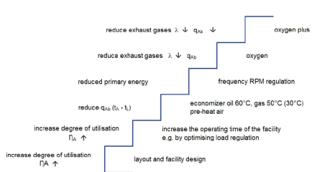
1.
An examination of current needs with an optimised regulation ratio of the
burners to attain a continual operation of the burners without unnecessary
start and stop sequences
2.
The use of feedback control technology – and in association, the optimal use of
technical possibilities, especially those in the regulation ratio of burners, repre-
sents a large step in the directions of establishing efficient firing plants
3.
Reduction of all possible exhaust-gas losses by reaching a lowest possible differ-
ence between the burner air temperature and the exhaust-gas temperature. :
a. use of exhaust gas heat exchangers
b. in plants where the low temperature level exceeds 100°C, preheated burner air
offers an alternative
4.
Use of high-tech burner technologies
such as
Ä
Ä
frequency
- RPM regulated burner
ventilators
Ä
Ä
oxygen
- high grade oxygen regulation
with low measurement inaccuracy
Ä
Ä
oxygen plus
- use of an additional
sensor in the exhaust-gas for the de-
tection of unconsummated elements
and repeated reduction of the exhaust
volume
The Initiative for Energy Efficiency
Efficiency steps
Steps to increasing the plant’s degree of utilisation
Many plants in operation have not been
sufficiently adjusted and modernised
to meet the latest demands of heat and
steam consumers. Time-tested and effi-
cient techniques used in energy con-
servation such as exhaust-gas
heat exchangers, adaptive pow-
er and follow-up controls, RPM
regulated pumps and burner
ventilation as well as oxygen and
CO regulation were often not im-
plemented. BDH sets the poten-
tial savings of such technologies at
ca. 4.43 bn cubic meters natural gas
≍
16.3 m to CO
2
along with a reduc-
tion of primary energy needs of ca.
398 MW.